Assi Meshullam is an artist and associate professor in the Department of Fine Arts at the University of Haifa, which he headed from 2017 to 2022. He holds a BA in Art and Archaeology and an MA in Biblical Studies, and has been active in the art field since 2000. His artistic practice is deeply engaged with ritual, archaeology, and the relationships between humans and their objects, extending across a wide range of media, from drawing, painting, and sculpture to installation, video, and digital art. Writing, too, accompanies his practice as an integral part of his visual work. Meshullam lectures, teaches, and mentors in various contexts.
I once heard a joke whose source I have trouble recalling. It was about Niels Bohr, a Nobel laureate in physics, who hung a horseshoe for good luck above the entrance to his home. A fellow academic who came to visit asked him why he had done so, since surely he did not believe in superstition. “Of course I don’t believe in it,” Bohr replied, “but I understand it brings you luck whether you believe in it or not.”
As a visual artist who has spent much of his life engaged with relationships with materials and objects to which I attribute meanings that extend beyond their utility, I am fascinated by our relationship, as human beings, with our ostensibly inanimate surroundings. The relationship between the essence of a thing and its appearance, its emotional effect on us, and the connections among ourselves and between ourselves and the world that thing mediates have been subjects of inquiry for me throughout my years as an artist, writer, and mentor of creative processes. My curiosity reaches its height when it comes to the spiritual and mystical relationships we maintain with the objects in our lives – relationships which I seek to understand despite my strong commitment to rationalism and a materialist conception of the world. In this article, I seek to offer a perspective on amulets and magical objects, one that I have been formulating in recent years through my professional and academic practice.
All of us, even the most secular among us, attribute meanings to objects and images that extend beyond their physical boundaries. We wear wedding rings, carry photographs of our children in our wallets, keep special stones we have found, inscribe tattoos onto our bodies, and even affix a mezuzah to the doorpost, whether or not we believe in God (“it won’t help, it can’t hurt”). Certain objects are perceived as possessing a special presence even when we do not attribute supernatural powers to them; they evoke emotions, preserve memories, mark commitment and belonging, and sometimes even provide us with a sense of protection, security, and meaning. For some reason, however, amulets are associated in our minds with another world. They are identified with traditional religions, magic, and superstition, and so even if I wear a wedding ring, have a tattoo depicting a mythological creature with which I identify, and wear a pendant I received from my grandmother that has been passed down through generations of my family, I may still regard people who believe in the spiritual power of certain objects as “amulet kissers,” idol worshippers, or simply as human beings who have “fallen” into primitive belief. But if a ring, a sentimental family heirloom, or even a flag is not perceived as mere matter, but rather as an object capable of shaping emotions, identities, relationships, and behaviors, is the difference between such objects and amulets really so fundamental?
Modern Western tradition, profoundly influenced by Cartesian1 dualism between matter and spirit and by the sharp distinction between subject and object, tends to regard the meaning of objects as the result of human projection, while the object itself remains passive and powerless. All of its meaning derives from the human consciousness that attributes value to it. From this perspective, amulets are nothing more than expressions of a cognitive error or an unfounded religious belief, while the objects surrounding our everyday lives are entirely inert, neutral, and indifferent to their own existence and to ours, including to any meaning that has become attached to them. In this article, I would like to propose a different perspective. Rather than asking whether amulets work, or what supernatural powers are attributed to them, I wish to examine what they do within the web of relations between human beings, bodies, materials, stories, and memories that constitute our cultural reality. From this perspective, I argue that an amulet is not an exceptional object endowed with mysterious properties, and that its power resides neither solely within the object itself nor solely in human consciousness. Rather, as I will attempt to show, the amulet is a kind of nexus of relations, emerging within a network of connections in which matter, body, culture, and memory act together and shape one another.
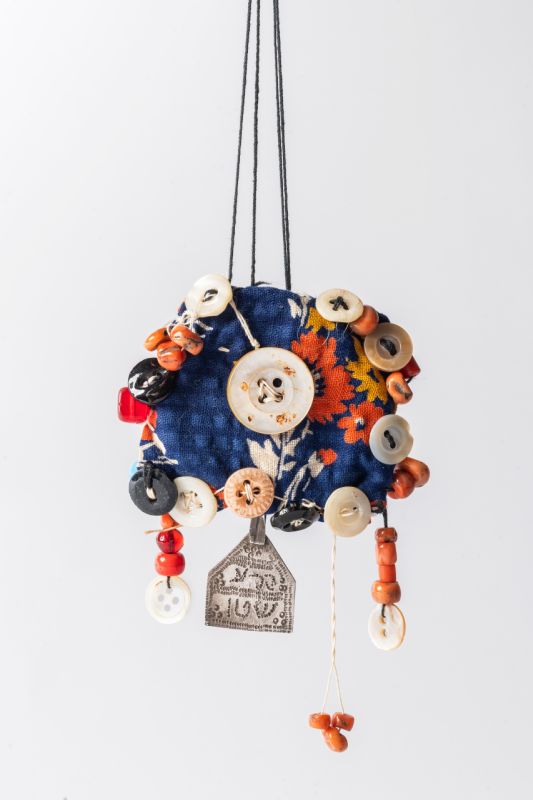
Amadiya, Kurdistan
First half of the 20th century
Fabric, paper, salt, metal plate with the Hebrew inscription Kra Satan; coral, amber, blue beads, buttons threaded on a string
Bequest of Erich Brauer, Jerusalem, to the State of Israel; Permanent loan from Israel Antiquities Authority
Photography © The Israel Museum, Jerusalem, by Eli Posner
What Do Objects Do?
At first glance, and from an atheistic perspective, objects seem to be among the simplest entities in the world: a stone is a stone, a ring is a ring, a mezuzah is a box, and a pendant is a piece of metal shaped in a particular way. From this standpoint, the object is a passive entity whose properties are determined solely by its material structure. Any additional meaning attributed to it – love, holiness, memory, luck, or protection – is understood as content originating exclusively in human consciousness. Human beings are the agents, while objects are merely the surfaces onto which we project our emotions and beliefs. This conception is deeply rooted in the Western philosophical tradition and can be traced as far back as Plato and Aristotle. The distinction between subject and object, which emerged as early as classical Greece and became entrenched in the modern era, created a profound rift between the conscious human being and the material world surrounding them2. Within this framework, objects can at most represent ideas, evoke events, or generate moods, but they do not themselves participate in the creation of human relationships. When a person attributes actual power to an object, we tend to regard that person as someone holding a mistaken belief who, as a remnant of pre-scientific thinking, projects psychological and emotional content onto the objects of their belief.
Yet if we simply open our eyes, we can see that everyday life repeatedly unsettles this straightforward distinction. If objects were merely neutral entities, it should be possible to replace any wedding ring with another ring that was materially identical, without difficulty. Any family photograph we possess could be replaced by a newly printed copy, and the pendant I received from my grandmother could just as well have been manufactured yesterday in a factory. In practice, however, this is not how we relate to our objects. We handle them with care. We carry them with us, pass them on to our children, and sometimes even bury them alongside our dead. The important question, then, is not what the object symbolizes for me, but what it does: how it changes my behavior, organizes my attention, resonates with my memories, embodies my commitments, shapes my identity, or alters the way I experience the place and time in which I live. A wedding ring does not merely symbolize my deep bond with my partner; it participates in the everyday maintenance of our relationship. It is worn on the body, visible to others, reminds both of us of the commitment we have made to one another, and directly, even if not always consciously, affects our relationship. Similarly, a mezuzah affixed to a door is not merely a symbolic representation of holiness or of protection for the home. It organizes the threshold of the house, accompanies entry and departure, invites particular bodily gestures, and incorporates the domestic space into a broader network of tradition, community, and cultural memory.
The object does not act alone, but neither is it passive. Its action takes place within an entire web of relations in which human beings, bodies, materials, gestures, memories, stories, and institutions continually shape one another. The power of an object is not an intrinsic property residing within it, but neither is it an illusion produced solely by consciousness or the result of an erroneous or pre-scientific epistemology. The object’s power is a consequence of its active participation in a network of relations, which grants it a certain degree of agency. The question that ought to be asked, in my view, is not whether a given object possesses magical power, but how it becomes a participant in the creation of the social, emotional, and cultural reality within which it operates.
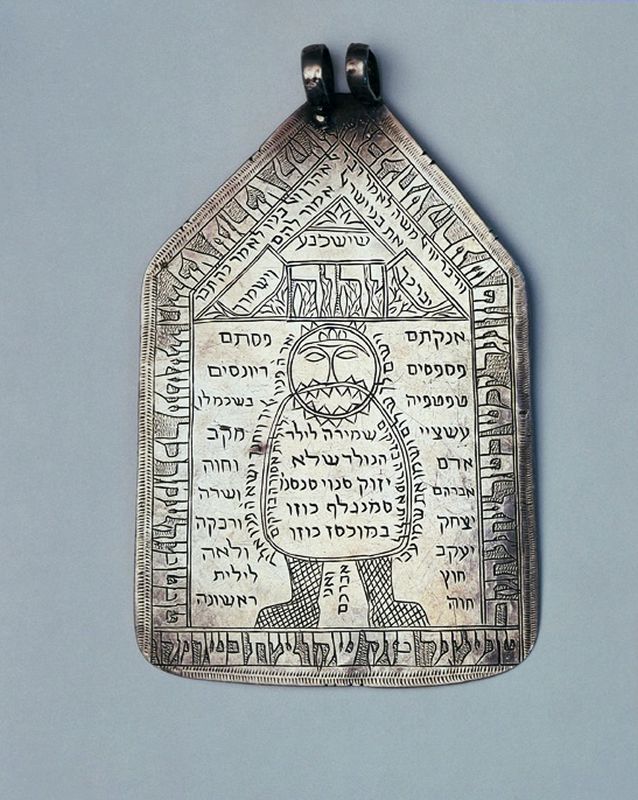
Iran
19th century
Silver, engraved
The Feuchtwanger Collection, purchased and donated by Baruch and Ruth Rappaport, Geneva
Photography © The Israel Museum, Jerusalem, by Eli Posner
From Object to Nexus of Relations
Over the past several decades, a profound shift has taken place in philosophy, anthropology, and the social sciences in the way human beings, objects, and the relations between them are understood. Rather than viewing the world as an assemblage of separate entities, each possessing predetermined properties, an increasing number of scholars have proposed understanding reality as a dynamic network of relations in which entities themselves emerge through the contexts in which they participate. Thinkers such as Alfred North Whitehead3, Gilles Deleuze and Félix Guattari4, Edmund Husserl5, and others have challenged the very ways in which we understand what an object is, what action is, and what constitute cognition and identity, laying the groundwork for a radical shift in perspective that is now sometimes referred to as the relational turn. A stone is never merely a stone, a dog is never merely a dog, a person is not merely a person, and an amulet is not simply an object. Each is a temporary node within a broader web of material, bodily, social, historical, and symbolic relations. Their properties do not precede these relations; rather, they are formed through them. The question shared by all the fields of knowledge mentioned above, and by many others, is no longer simply “What is this thing?” but “What relations does it participate in?” and “What becomes possible through these relations?” Meaning, power, and agency are understood here not as intrinsic properties of distinct entities, but as products of their encounters with one another.
From this perspective, actions no longer belong to a single entity either. When a person writes with a pen, plays a violin, or wears a ring, the action cannot be attributed exclusively to the person. The action takes place in the encounter between subject and object, between a person and their writing instrument, or between a person and their musical instrument. The body is transformed through the tool, while the tool acquires its meaning and capacity to act from the body that uses it (or perhaps it would be more accurate, from now on, to call it “the body that participates in the action with it.”)
This conception stands in contrast to the Cartesian tradition, in which the subject is the source of intention and action, while the objective world serves as a passive backdrop. The relational turn proposes that reality be understood as an ongoing process of mutual becoming. Human beings shape their environment, but are equally shaped by it. They create objects, but they also become who they are through the objects that accompany their lives. Relations do not take place between entities that already exist in completed form; rather, they are the condition of their emergence in the first place. This can easily be demonstrated through the way the human species itself evolved together with the tools it learned to develop, from the first stone axe to today’s most advanced technologies.
These ideas appear in different formulations in the work of a range of contemporary thinkers who seek to transform the way we understand reality. Bruno Latour, for example, proposed understanding society as a network of human and nonhuman actors, in which objects, documents, technologies, and animals also participate in the production of social and cultural reality6. Donna Haraway demonstrated that the human has never existed as an autonomous and separate entity, but rather as a hybrid being continuously woven from relations with animals, technologies, languages, and material systems7. Jane Bennett seeks to restore vitality to matter, demonstrating that materials are not merely the backdrop to human action but active participants in its unfolding8. Tim Ingold, influenced by Whitehead and Latour, describes the world not as a collection of objects but as a meshwork of lines, movements, and flows, in which things emerge through ongoing processes rather than fixed essences9. Physicist Karen Barad applies these ideas to quantum physics, arguing that interactions constitute the basis of reality even among the smallest “particles”10.
Despite their differences, what these and other thinkers not mentioned here have in common is the premise that the world is not composed of closed entities that enter into relations with one another, but of relations from which entities themselves emerge. This shift also makes it possible to rethink phenomena such as amulets and magic. Instead of seeing the amulet as an exceptional object onto which a particular belief has been superimposed, I invite us to understand it as an especially dense nexus of relations. The question, as noted, is not whether the amulet contains power, but how it organizes a network of relations within which meanings and effects emerge.
Wedding Kit
In the exhibition “To Go: New Designs for Jewish Ritual Objects”
Box: cardboard; wedding canopy: brass; cups: dried orange peel; rings: stone and concrete; pegs and hammer: wood and brass
Collection of the artist
Video and editing © The Israel Museum, Jerusalem, by Amir Ronen
The Hybrid Being
The modern Western separation between subject and object as distinct categories of existence becomes increasingly difficult to sustain when we examine how human beings actually exist in the world. It is difficult to identify a single moment in human life in which one acts without being entangled in an array of objects, tools, technologies, and materials that accompany them and shape the possibilities of their action. From the very beginning of prehistory, human beings have never existed independently of the tools they create. The hand axe, knife, needle, or spear were not merely technical means that enabled survival; they altered the structure of the relationship between the body and its environment. They extended the range of the human hand, changed the perception of space, altered the capacity to act across time, and so forth. The tool was never merely an external addition to the human body, nor even simply an extension of it; it is one of the conditions through which the human being as we know it came into existence.
I like to illustrate this through the example of hermit crabs (Paguroidea). These crabs use the shells of marine snails as protection for the rear portion of their bodies. The crab finds an empty shell, enters it, and uses it as a permanent form of armor. As the crab grows, it exchanges the shell for one of a more suitable size. The shell is not merely a tool or prosthesis that the crab uses; over the course of evolution, it has become an inseparable part of the crab itself – the crab’s abdomen is so soft and vulnerable that it has no possibility of surviving without it.
The human body, too, does not really end at the boundaries of the skin. We wear clothes and shoes in order to enable freer movement through space. Some of us wear glasses in order to see in ways that make our independence possible. When a person holds a walking stick, drives a car, writes with a pen, or uses navigation software, the boundaries of their capacity for action shift, and the tool becomes part of the body’s perceptual and operative system. The body adapts to the tool until, at times, it becomes difficult to distinguish between the two. The relationship between a person and an object is not a relationship between two separate entities, but an ongoing process of mutual adaptation in which each side transforms the other.
The cyborg metaphor proposed by Donna Haraway in her first manifesto, although borrowed from the genre of science fiction, did not offer a futuristic vision. Rather, it sought to describe a fundamental human condition: the human has never been a pure and autonomous entity, but a hybrid being formed through ongoing relations with different technologies, organisms, and materials. These principles also apply to objects that lack an obvious instrumental function: rings, amulets, jewelry, mezuzot, and other objects bearing emotional or spiritual significance likewise alter the ways in which human beings move through the world, remember their past, perceive their bodies, and establish relationships with other entities, both human and more-than-human. The difference between these objects and a hammer or a knife is not that they are “less real,” but that the relations they organize operate primarily on the mental planes of memory, identity, and feelings of belonging and commitment. The amulet is not an exception among the other objects that accompany us. It is a direct continuation of this same hybridity, expanding the network of relations within which we exist. The magical object connects the body with our memories, hopes, anxieties, and traditions, thereby altering modes of bodily action no less than a tool or technological device. Since emotional, social, and symbolic action shapes the ways in which we live and act within the world, these are objects with tangible implications for our lives and for the lives of those around us.
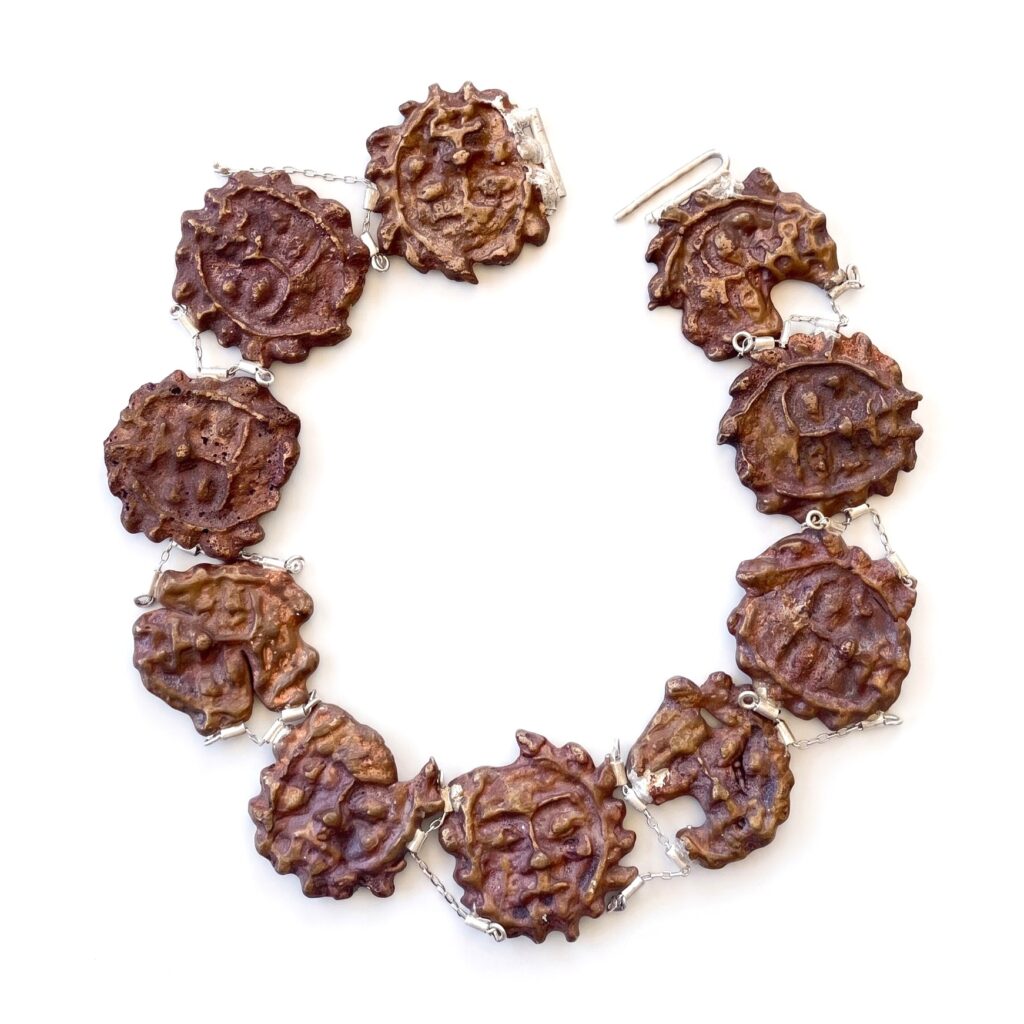
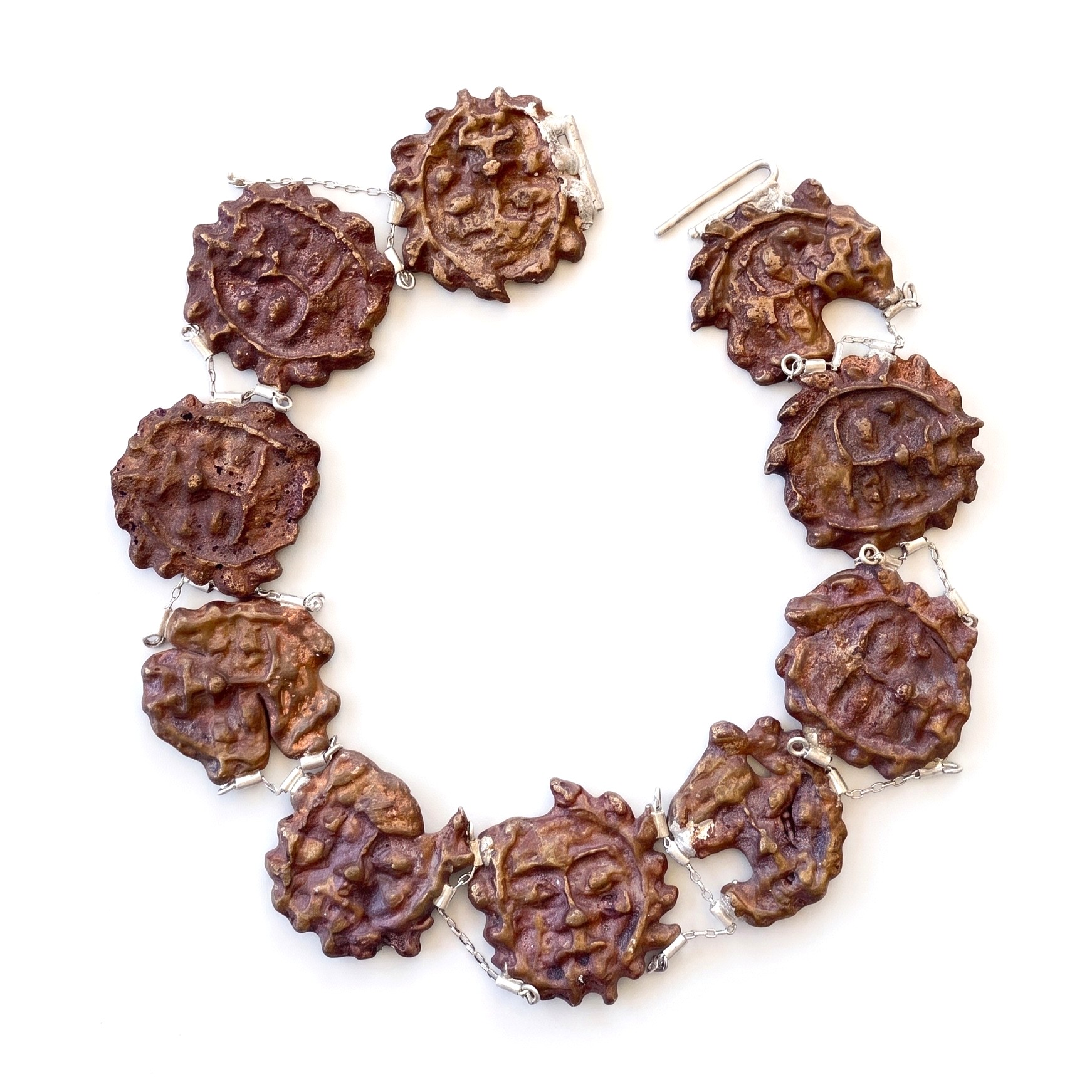
Nava Hadar Avnit
Monster Necklace, 2023
Choker
From the graduation project Now That He Has Been Created, supervised by Prof. Einat Leader, Bezalel Academy of Arts and Design, Jerusalem
Copper, silver 925
Photography: Nava Hadar Avnit
How Does an Object Become an Amulet?
If an amulet is neither an object possessing an internal power nor a projection of human belief onto inert matter, the question arises: how does any object become an amulet? What distinguishes a stone lying on the ground from a stone worn around the neck? A ring purchased in a store from a ring passed down through generations? A piece of parchment from a mezuzah, or a decorative figurine from a ritual object? Within modern thought, the answer is generally sought in one of the two directions already mentioned above – in the object itself or in the human consciousness that projects onto it. But if we adopt a relational perspective, it seems that the question itself needs to be reformulated.
An object does not become an amulet because some mysterious power has been added to it, nor because a person has begun to believe in it. It becomes an amulet when it begins to participate in a particular network of relations – relations that a person must enable. The amulet is a particular mode of connection between different factors, including the person, the materials from which the object is made, the meanings it embodies, and so forth. From this perspective, there is no single moment at which an object becomes an amulet, because the process is one of continuous becoming, in which the object is repeatedly charged through use, touch, transmission, storytelling, and ritual action. The more deeply it becomes integrated into such relations, the more effective the amulet becomes within the network in which it operates. Its power is not a property residing within it, but the result of the relationship it succeeds in establishing.
Let us return to the example of writing mentioned in passing earlier. It is commonly said – and thought – that a person writes by means of a writing instrument. In fact, however, the act of writing is the outcome of a complex system that includes the human body (from the brain and the nervous and circulatory systems to the smallest muscles), paper, ink, language, cultural conventions, and the technology of writing itself. A change in any one of these components alters the nature of the entire action. Writing with a fountain pen is entirely different from writing on a keyboard, and both are fundamentally different from writing with a brush or engraving on stone. Anyone who has ever written with both a pen and a keyboard knows the profound difference between the two, in terms of the sensations and experience of writing that they produce. This is not merely a change in the means of expression, but in the way thought itself operates and in the meanings that emerge from it. Agency does not reside solely in the mind of the person writing; it emerges from the shared system of relations created in the encounter between the person and the tool participating in the event.
This idea also unsettles the traditional distinction between “useful” and “symbolic” objects. It is commonly assumed that a pen or computer actively participates in shaping a person’s actions, whereas a pendant, ring, or amulet is, at most, a carrier of psychological or cultural meaning. Yet this distinction is arbitrary. Symbolic objects, too, alter the ways in which human beings act, perceive themselves, and relate to others. The material from which the amulet is made, the manner of its production, the symbols engraved upon it, the body that carries it, the memories associated with it, the gestures repeatedly performed around it, and the cultural narrative within which it operates – all of these converge into a single system that cannot be reduced to any one of its components.
Every amulet therefore exists across three interwoven relational dimensions. The first is the material dimension, which encompasses the material itself, its weight, texture, origin, and the manner in which it comes into contact with the body. The second is the symbolic dimension, which includes the images, letters, myths, and cultural meanings that accompany it. The third is the practical dimension – the ensemble of actions and habits that the amulet invites: wearing, carrying, touching, kissing, blessing, praying, passing it from one generation to the next, burying it, or dedicating it. Only the combination of these three dimensions enables an amulet to become more than a mere object and to become an entity that operates within the human world in a “magical” manner.
The meaning of an amulet is neither stable nor essential. Much like a work of art – and particularly a readymade11, the same material object can be an insignificant object in one context and a powerful amulet in another. The transformation occurs within the new web of relations woven between matter and consciousness, between the object being carried and the person carrying it. The amulet is an ongoing relational event in which matter, body, meaning, and practice continue to shape one another over time.
1. Embodying Relations in Matter
These three types of relations – material, semiotic12, and practical – give rise to three types of actions through which an object becomes an amulet. The first is the anchoring of relations in the material world: meaning does not exist in an abstract space; it requires a body. Matter embodies relations and gives them weight, volume, durability, and location – whether on the body or in the space external to it. It allows them to persist beyond the fleeting moment and to continue operating even when the person who endowed them with meaning is no longer present.
Different cultures have attributed great importance to the raw materials from which their amulets were made. Gold, silver, stone, wood, bone, shell, skin, or water were not regarded as interchangeable. Each material created a different system of relations with the body, the environment, and time. Not because the material contains a hidden power, but because its actual properties actively participate in shaping the ways in which human beings experience and use it.
Gold, for example, is not merely a symbol of divinity or royalty. Its rarity, resistance to corrosion, and enduring luster create a unique relationship with the dimension of time. This material hardly changes at all, and therefore embodies ideas of continuity, eternal life, and authority. Stone, by contrast, anchors relations in the earth and in deep, ancient geological time. It evokes a sense of stability, antiquity, and belonging to a place. Wood, carrying the traces of its growth and the memory of the seasons from which it emerged, establishes entirely different relations with the body: it is warmer to the touch, changes over the years, and evokes the cyclical nature of life. Water moves between bodies, places, and times, and therefore anchors relations of flow, purification, and continuity.
These are not merely arbitrary associations. The various symbolic traditions have indeed developed rich systems of meaning around each of these materials, but these systems are not detached from the physical qualities of the materials themselves. In many cases, cultural meaning develops out of the sustained encounter between the human body and the actual properties of matter. The cool touch of stone, the relative warmth of wood, the luster of gold and silver, the softness of fabric, or the fluidity of water establish the relations through which matter itself becomes meaningful13.
Even when a modern, rational person does not believe in the magical power of a particular material, that material continues to participate in organizing their relationship with it. A brass ring and a gold ring may carry the same legal significance, but they do not produce the same bodily, emotional, and social experience. A mezuzah made of plastic and one made of ancient olive wood do not organize the same relations, even if both contain exactly the same parchment scroll. I am not necessarily arguing for a hierarchy between materials considered “cheap” and those regarded as more precious or rare. Rather, I am arguing that matter participates in the creation of meaning, and that different materials therefore give rise to different experiences and meanings.
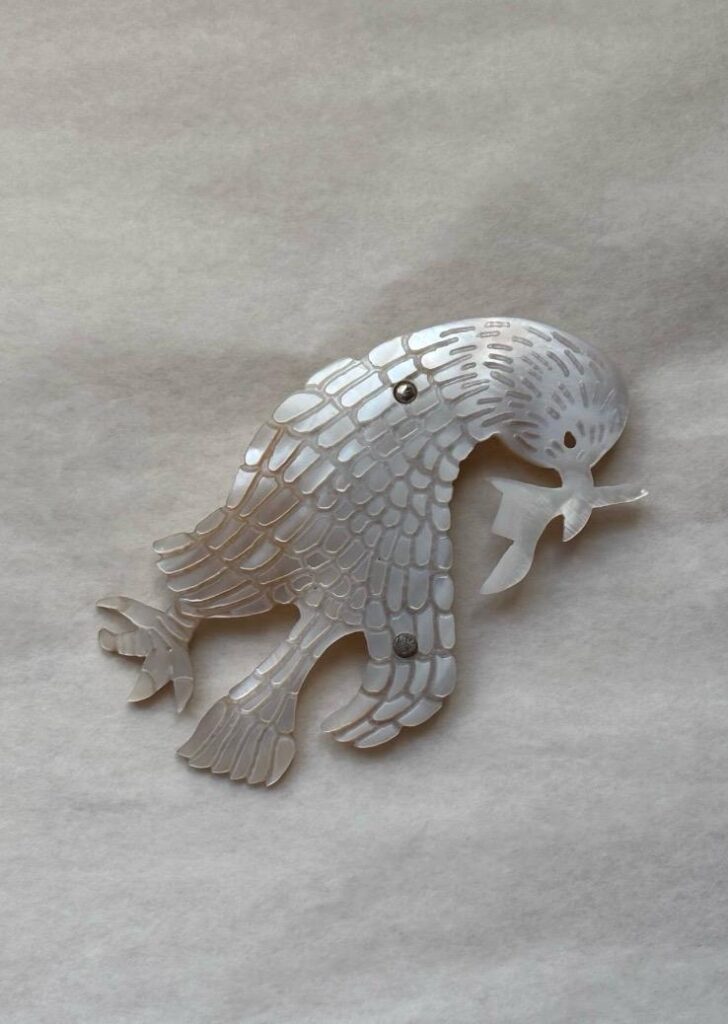
Shahar Cohen
“Recumbent dove with head twisted back/ this piece had a title”
Brooch, mother-of-pearl, stainless steel, 2024
2. Organizing Relations through Symbolic Language
If matter anchors relations in the material world, the symbol is what directs and channels the way those relations are organized. Symbols are not merely cultural decorations added to an object after it has been created, nor are they only means of communication whose function is to convey meaning, as is commonly assumed. They participate actively in the creation of patterns of action, memory, and emotion, thereby directing the ways in which human beings relate to the world and to one another.
The conventional distinction between sign and symbol helps clarify this point. A sign generally points to a defined and agreed-upon thing: a road sign, a price sticker on a product, or an arrow directing us toward a particular place are intended to convey information as clearly as possible. A symbol, by contrast, cannot be reduced to a single meaning. Rather, it gathers around itself multiple layers of association and often operates on levels that are not entirely conscious. Precisely for this reason, a symbol is capable of organizing more complex systems of relations than a functional sign.
From a relational perspective, the power of a symbol does not lie in its representation of an abstract idea, but in its ability to direct the way different relations encounter one another. A snake, for example, is not merely an image of a snake. It simultaneously evokes the body, our evolutionary and archetypal memory, stories of creation, medicine, renewal, eros, danger, and wisdom. It is a symbol that functions as a kind of nexus in which traditions, emotions, memories, experiences, and information converge and act together14.
If we think about it, the symbol does not add meaning to the world; rather, it organizes different relations of meaning that already exist and assists in the creation of new ones. When a person wears an amulet in the shape of an eye, this is not merely an image that recalls the idea of protection and warding off misfortune. The very presence of the eye on the body alters the relationship between the person and their surroundings, creating a new focus of attention and action.
This also explains the power of symbols to cross cultures and historical periods. Their meanings may certainly change from one place to another, yet they continue to function as focal points for the organization of relations. The sun, tree, snake, circle, hand, fish, or eye have not endured for thousands of years because they transmit a fixed message, but because they are repeatedly capable of organizing new networks of relations in response to changing contexts. Even if we take into account the Jungian notion that these symbols ultimately emerge from a shared substratum of human experience, their power does not lie in semiotic stability but rather in their flexibility and their ability, each time anew, to bind together bodies, materials, stories, and experiences within different and emerging contexts.
From this perspective, we can also understand the place of letters in various magical traditions. Belief in the power of letters does not necessarily arise from the assumption that graphic signs themselves possess supernatural power, but from the fact that letters are perceived as structures capable of organizing relations between human beings and the world. In Kabbalistic traditions, for example, letters actually participate in creation rather than merely representing it. Combinations of letters, sacred names, or verses are not simply written information. They are understood as frameworks within which the world is given order, direction, and meaning.
The power of the amulet thus derives from the way in which the symbol succeeds in channeling the relations previously anchored in matter. Gold without symbolic meaning may remain a precious metal, but gold incorporated into a symbolic context – for example, through its association with the sun, an association found in various cultures – becomes a significant relational nexus, with heightened agency.
3. Activating and Maintaining Relations
Even when relations have been anchored in matter and channeled through symbols, this does not mean that the amulet is already “working.” Relations do not sustain themselves; they require continual maintenance, repetition, use, sharing, and renewal – ritual. For this reason, in almost every culture in which amulets appear, they do not remain passive objects but become integrated into a set of actions repeated over time.
The amulet is worn on the body, wrapped around the arm, hung at the entrance to the home, carried in a pocket, touched against the skin, anointed with oil, buried in the earth, passed down as an inheritance, written as part of a ritual, read aloud, or kissed upon entering and leaving the house. These actions should not be understood as external additions to the object, but as an integral part of the way in which it exists as an amulet. They repeatedly renew the network of relations within which the amulet operates.
From this perspective, the distinction between object and action also becomes less clear-cut. An amulet is not merely a thing a person carries with them, but an entire constellation of gestures, habits, and bodily movements. A wedding ring does not exist “in full” merely as a metallic object, but through its daily wearing, the glances directed toward it, the casual and unconscious caress, the ritual through which it was given, the stories attached to it, and the decision never to remove it from the finger. Each of these actions actualizes the relations organized by the ring.
Similarly, a mezuzah is not merely a parchment scroll enclosed within a case. The mezuzah exists through repeated passage across the threshold of the home, touching it, kissing it, the slight slowing of movement, and heightened awareness of the transition between outside and inside. Even when these actions are performed almost automatically, they continue to renew the relationship between body, home, memory, and tradition. The amulet is not simply there. It is made – it undergoes becoming – anew each time this system of relations is activated.
The same is true of objects we would not ordinarily call amulets. A flag does not exist merely as a piece of fabric. It becomes a flag through being raised, saluted, incorporated into state ceremonies, and through the collective memory it embodies. The Torah scroll is not merely an ancient manuscript. It becomes what it is through public reading, being carried in procession, being kissed, and being dressed in fabrics and crowns. Even a family photograph derives its power not only from the image it bears, but from where it is placed, the repeated gazes directed toward it, and the conversations it provokes. The power of objects does not reside in them alone, but in the network of actions through which they are continually actualized.
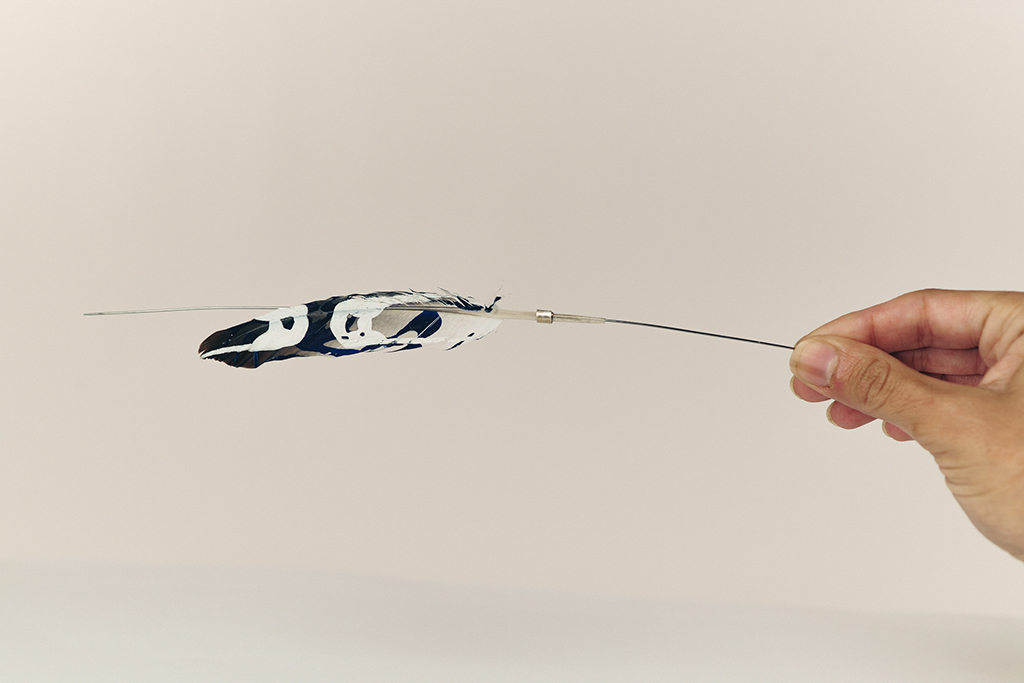
Maya Ganga Ofer Agababa
Safety Feathers, 2026
Brooch
Created as part of the course Initial Language, supervised by Prof. Einat Leader, Bezalel Academy of Arts and Design, Jerusalem
Screen-printed feathers, stainless steel
Photography: Shalev Ariel
Conclusion
This article has not sought to determine whether amulets possess supernatural power, nor to negate their significance through psychological or sociological explanations. Instead, I have proposed reformulating the question itself. Rather than asking whether the amulet works, I have asked how it works. Rather than locating the source of its power in the object itself or in human belief in it, I have proposed understanding the amulet as a relational event – as an ongoing process of becoming through relations between body, matter, symbol, memory, practice, and community.
These considerations raise a broader question: Why do human beings continually create amulets, jewelry, monuments, flags, mezuzot, and other objects charged with meaning, in almost every culture and historical period? Why do we not settle for memory, beliefs, or emotions in and of themselves?
In my view, the answer lies in the fact that human relationships do not exist solely on an abstract plane. As Heidegger15 and Merleau-Ponty16 teach us, the human being does not stand before the world as a neutral observer; they are always already in the world. They live, act, and perceive reality through their body, and therefore their relationships with objects are not merely external relations, but part of the way in which they dwell in and come into being within the world.
Consequently, love, commitment, mourning, hope, belonging, or holiness cannot remain merely abstract ideas. Each seeks to take form in the world. Human beings seek to touch their relationships, carry them on their bodies, place them in their homes, pass them on to their children, and make them part of the material environment in which they live. The amulet is simply an extreme expression of this human tendency to give bodily form to systems of relations.
Almost every significant relationship ultimately becomes embodied in matter. This is how culture operates. Marriage receives a ring, memory receives a gravestone or photograph, collective identity receives a flag, and personal identity receives clothing and makeup. Belief becomes embodied in a book, a structure, or a ritual object; love appears as a gift or a bodily gesture. We do not create these objects because the relationships would not exist without them, but because matter allows relationships to become stabilized, endure, and continue to operate beyond the fleeting moment of our experience. It enables them to become present in the world.
From this perspective, magic, too, acquires a new meaning. It need not necessarily be understood as an attempt to violate the laws of nature or control hidden forces. Magic is simply one of the ways in which human beings organize their relationships with the world. When a person hangs an object intended to ward off misfortune above the entrance to their home, they participate in an action that gives their relationship with the world a material and enduring form. In this sense, the magical act is not a departure from human existence but a concentrated expression of one of its fundamental characteristics. And so, the scientist in the joke with which I began does not need to believe in the amulet for it to work.
In conclusion, the relational reading proposed here seeks to shift the center of gravity from the question of whether objects contain power to the question of how they participate in its production. Amulets are not exceptional objects, but cultural technologies through which human beings anchor, channel, and enact their relationships with the world. Their power resides neither in matter alone nor in consciousness alone, but in the network that continually emerges between them.
The question “Do amulets work?” rests on a false premise. It assumes that an amulet is an object, and that what we must determine is whether it possesses the power to exert an influence. But if the amulet is, first and foremost, an event of relations, then the more important questions are not whether it acts, but which relations it makes possible, which forms of life it stabilizes through those relations, and what kind of reality it helps us bring into being.
- Descartes distinguishes between the mind as a thinking substance (res cogitans) and the body and material world as extended substance (res extensa), a distinction that came to constitute one of the foundational premises of modern philosophy.
↩︎ - This divide has come at a very high cost to animals, plants, communities, and entire ecosystems throughout modern history, and these costs are now knocking on the door of Western culture itself.
↩︎ - To understand Whitehead’s process philosophy, I would begin here: Whitehead, A. N. Process and Reality: An Essay in Cosmology. New York: Free Press, 1978 [1929].
↩︎ - Primarily in their seminal work, which explores concepts such as the “rhizome” and “becoming”: Deleuze, G. & Guattari, F. A Thousand Plateaus: Capitalism and Schizophrenia. Minneapolis: University of Minnesota Press, 1987.
↩︎ - In Husserl, in this context, I would turn primarily to The Crisis of European Sciences and Transcendental Phenomenology: Husserl, E. G. A. The Crisis of European Sciences and Transcendental Phenomenology. Evanston: Northwestern University Press, 1970 [1936].
↩︎ - See Latour, B., We Have Never Been Modern, trans. Catherine Porter (Cambridge, MA: Harvard University Press, 1993).
↩︎ - In Haraway’s work, two foundational texts are particularly relevant here. The first, A Cyborg Manifesto, was originally published in the United States in 1985 and was translated into Hebrew in 2006: Haraway, D. “A Cyborg Manifesto: Science, Technology, and Socialist-Feminism in the Late Twentieth Century.” In Learning Feminism: An Anthology. Hakibbutz Hameuchad, 2006. The second, published several years later, continued to explore the ways in which humanity has been co-constituted with the nonhuman beings that have accompanied it, particularly animals: Haraway, D. The Companion Species Manifesto: Dogs, People, and Significant Otherness. Chicago: Prickly Paradigm Press, 2003.
↩︎ - See: Bennett, J. Vibrant Matter: A Political Ecology of Things. Durham, NC: Duke University Press, 2010.
↩︎ - Particularly here: Ingold, T. Being Alive: Essays on Movement, Knowledge and Description. London: Routledge, 2011.
↩︎ - See: Barad, K. Meeting the Universe Halfway: Quantum Physics and the Entanglement of Matter and Meaning. Durham, NC: Duke University Press, 2007.
↩︎ - A readymade is a term for an artwork composed of a pre-existing object, typically a utilitarian object removed from its everyday context and transformed into a work of art. What changes is not the object itself, but the context in which it operates. This approach is most closely associated with the French artist Marcel Duchamp.
↩︎ - Semiotic relations are those formed through symbols, images, language, stories, myths, and systems of meaning.
↩︎ - Although not relational in its approach, and grounded in a distinctly Western perspective, the anthropologist James Frazer had already pointed out that, in magical thinking, the properties of a material are not perceived as arbitrary, but as bearing a real connection to the forces that the material represents or embodies. In his book, he distinguishes between two fundamental principles of magic: the Law of Similarity, according to which like acts upon like, and the Law of Contact or Contagion, according to which things that have once been in contact continue to affect one another even after they have been separated. These two principles help explain why raw materials, body parts, and certain objects are attributed with particular powers in magical practices. See: Frazer, J. G. The Golden Bough: A Study in Magic and Religion, abridged ed. (London: Macmillan, 1922), chap. 3.
↩︎ - See Jung: Jung, C. G. Man and His Symbols. London: Aldus Books, 1964.
↩︎ - See: Heidegger, M. Being and Time, trans. John Macquarrie and Edward Robinson (Oxford: Blackwell, 1962). Originally published as Sein und Zeit (1927).
↩︎ - See: Merleau-Ponty, M. Phenomenology of Perception, trans. Donald A. Landes (London: Routledge, 2012). Originally published as Phénoménologie de la perception (1945).
↩︎