“I Was Born of Stone”
A Solo Exhibition by Shirly Bar-Amotz
Ramat Hasharon Contemporary Art Gallery
Curator: Rachel Sasporta
Dates: May 1, 2026 – August 8, 2026
[Bio] Dr. Reuven Zahavi is an artist and researcher. He formerly headed the Jewelry Department at Bezalel Academy of Arts and Design and currently teaches in the Jewelry and Fashion Department and the Department of Visual and Material Culture. His practice spans painting, installation, and video art. In 2025, he published Bousbir Artist’s Book in Pursuit of the Women’s Trafficking District in Colonial Casablanca.
Wall relief
Mixed media
45 × 45 cm
Photo: Boaz Nobelman
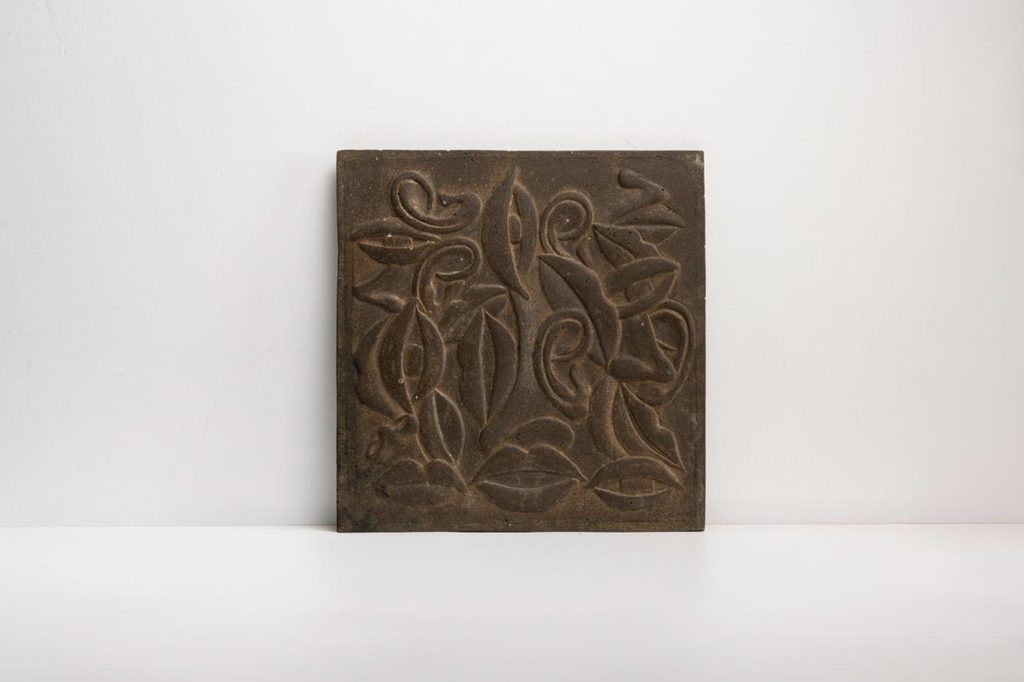
The delicate relief by Miriam Shiovitz, Shirly Bar-Amotz’s grandmother, catches the eye even before one enters the gallery itself, offering a surprising and inviting prelude to Bar-Amotz’s works in the exhibition curated by Rachel Sasporta at the Ramat Hasharon Gallery for Contemporary Art. The small work, dating from 1982, points the way, since many of the exhibition’s central works are reliefs of comparable format and chromatic range. Across the square relief is a swirl of facial fragments, an almost random scattering of lips and eyes, noses and ears, that at first glance resemble leaves. This choice is significant, functioning as a kind of key to a complex exhibition, for a dominant component is the series of reliefs that resonate with one another both thematically, through combinations of faces and plants, and through their material, chromatic, and sculptural affinities. The exhibition title, “I Was Born of Stone”, quotes Bar-Amotz’s other grandmother, in a compressed description of her life that Bar-Amotz takes up and makes her own, as a daughter of Kibbutz Ma’abarot, in relation to the experience of communal children’s sleeping arrangements and to her own path through life and art as an art jeweler with a singular voice.
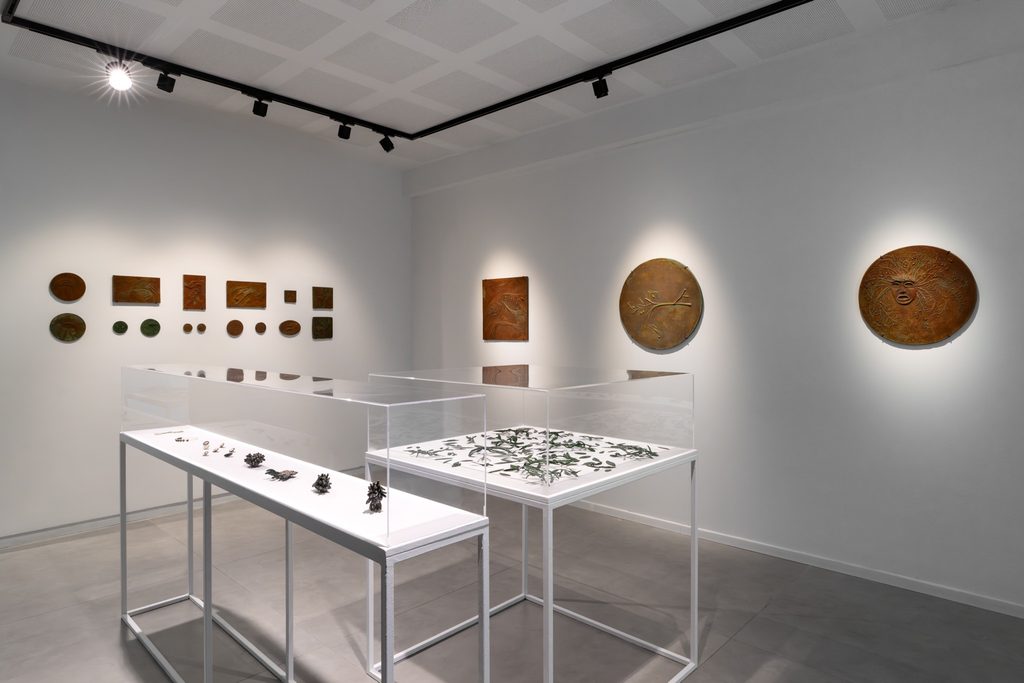
Photo: Daniel Hanoch
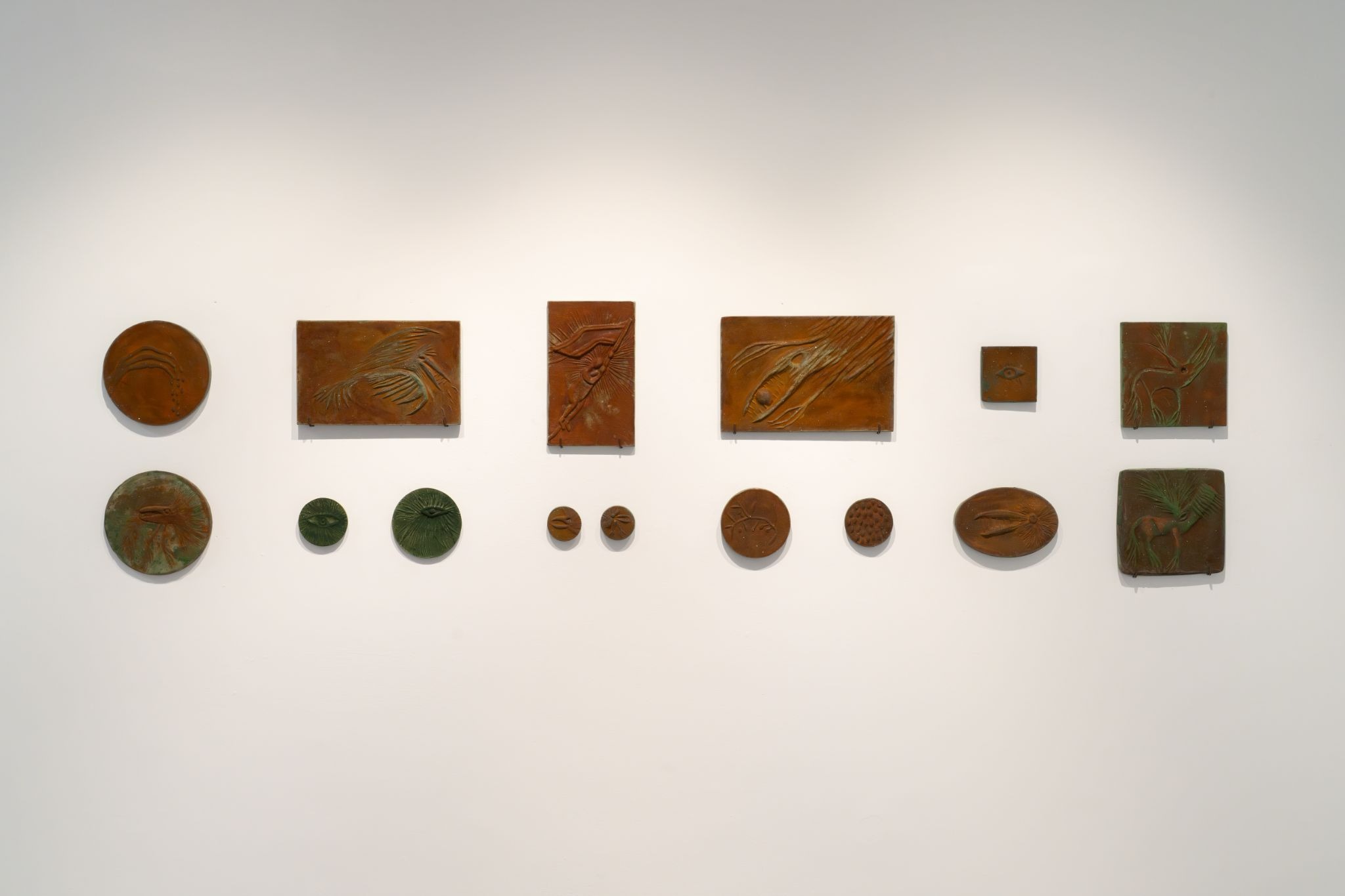
At first glance, one senses how comfortably the exhibition inhabits the small cube of the new Ramat Hasharon gallery’s clean, geometric space. The installation conveys decisiveness and precision, striving for perfection. Three dominant reliefs on the central wall draw the viewer inward through two display cases teeming with life at the room’s center, while to the left, a group of smaller reliefs in varying formats unfolds in two rows, each suspended from hooks with meticulous precision. Perfect, perhaps too perfect, the installation is inviting and absorbing, soliciting not merely a second look but a lingering gaze: a desire to decipher, investigate, and experience the craft in its entirety.
Yet another, less familiar facet of Bar-Amotz’s work is revealed here. The rough, playful, prickly, and unrestrained mode of making that has characterized her work for many years now moves in a different direction, one already intimated by Miriam Shiovitz’s relief. An initial period of looking among the works on the walls and in the two vitrines makes clear that the thinking in this exhibition is different. Its spirit is decidedly removed from “Outward”, also curated by Rachel Sasporta at the Geological Museum only a year ago. There, in 2025, the distinctive conception of presentation and content placed profusion, diversity, and spontaneous eruption at the core of Bar-Amotz’s work. That exhibition, in its content, experimental curatorial approach, and installation, emphasized multiple points of entry into and interpretation of her oeuvre. In the present exhibition, the selection of works generates a different climate: an avowedly coherent whole, a unity within multiplicity. A turn, perhaps, or the disclosure of another side of her practice? The striking sense of regimentation and meticulous coordination of relationships and flow among the sections structuring the viewer’s trajectory is remarkable. This unusual degree of over-control produces a balanced harmony and a deceptive calm, encouraging the viewer to linger and move attentively between the wall reliefs and the transparent cases containing sculptural objects/creatures, a collection of organic elements, and jewelry articulated in a related language.
Polymer plaster, diamond powder, iron powder
Diameter: 36 cm
Photo: Boaz Nobelman
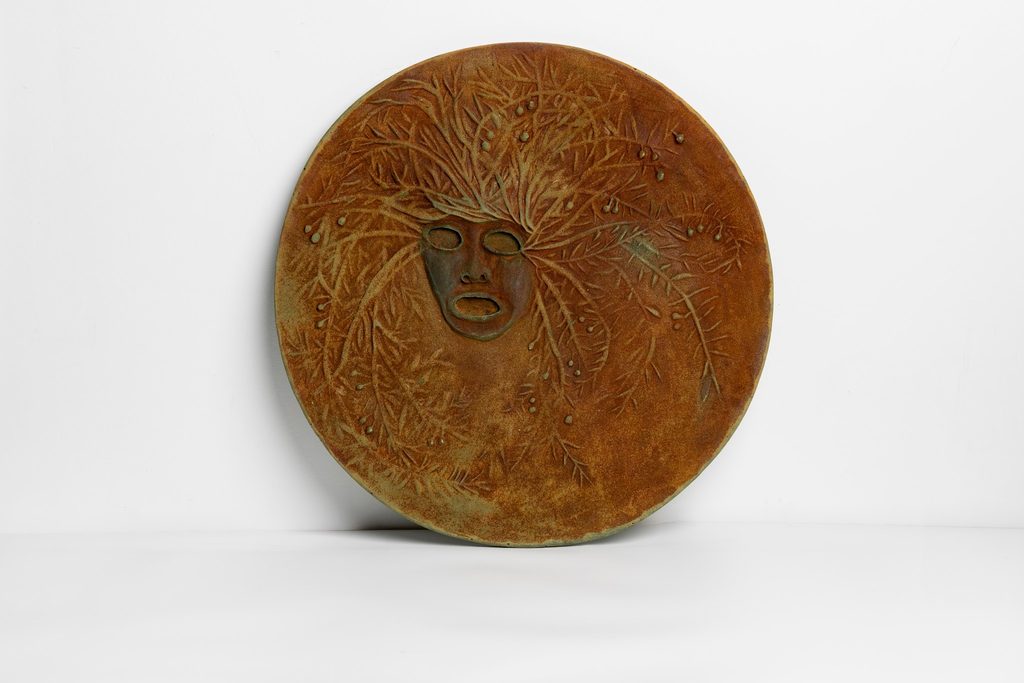
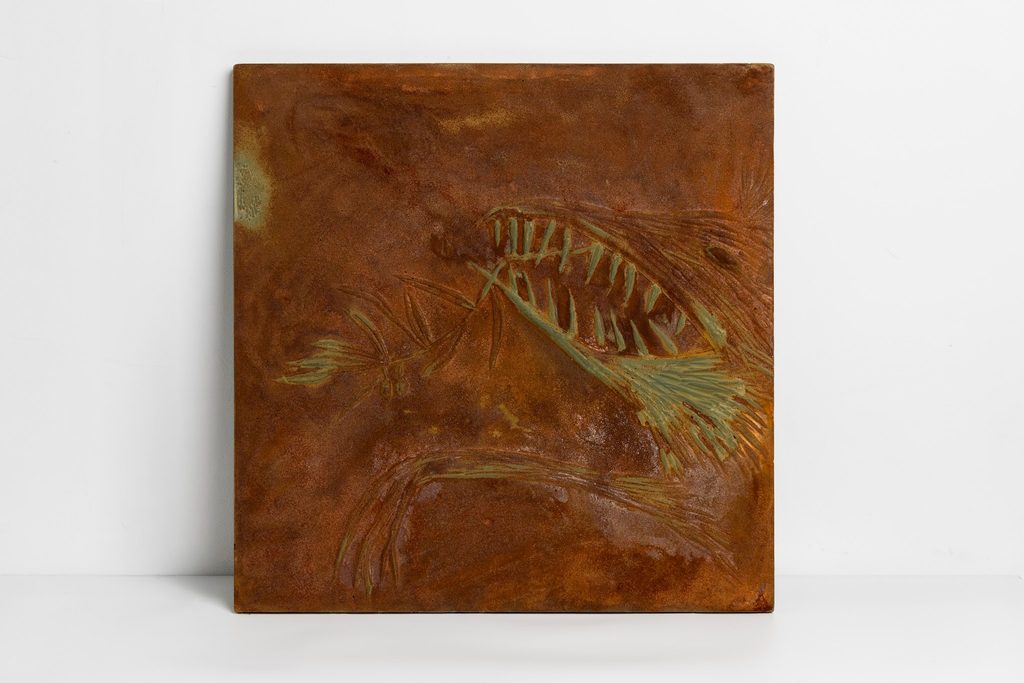
A second, more attentive look, however, unfolds an unsettling, oppressive, and nightmarish visuality. The initial illusion of calm produced by vegetal imagery across the mineral, powdery, abraded reliefs, which resemble archaeological remains, gives way to the unease aroused by monstrous creatures and terrifying animals incised into rectangular and circular plaques like ancient medallions. This polarity is intensified by the complex treatment of surfaces that are simultaneously granular and polished, gleaming and dusty, rusted and fossilized. Meticulous craftsmanship, guided by a sensitive hand and a practiced eye, tempts the viewer into a hallucinatory bestiary of strange creatures: hybrid, vulnerable, and dismembered, aged and ominous. Heavy in their movement, they seem to struggle free from layers of a material whose identity is never fully disclosed to the viewer. The nightmarish images and demons that inhabit these surfaces belong to marine, subterranean, or psychic depths. Across them all, branches, leaves, eyelashes, teeth, fingers, and fingernails float in a gravity-free space, carried upward or downward by an invisible yet palpable diagonal current. It is a dense and murky medium, a deep ground without horizon or points of purchase. The elements, like the flag raised by one of the figures, flutter or slowly sink, wrapped in hair, down, feathers, thorny horns, or olive branches, as in the most striking relief: the Medusa. It is a mask at once repellent and powerful, in which the olive branches adorning the severed head have replaced the mythological hair of snakes. Mouth and eyes gape open – apertures into empty space that likewise draw the gaze inward: a monster of emptiness, or of absence.
Polymer plaster, diamond powder, iron powder
50 × 50 cm
Photo: Boaz Nobelman
Beside the Medusa head is another relief depicting a simple olive branch, severed and drooping; next to it hangs a third, rectangular relief in which a plucked, exhausted bird (a dove?) holds an olive branch in its gaping, tooth-lined beak. The Medusa is a silent scream; the bird, an image of exhaustion or despair. Together, the triptych articulates a political, gendered, and consciousness-raising resonance.
Dimensions variable: 2-15 cm
Copper, vitreous enamel
Photo: Boaz Nobelman
The sculptural language Bar-Amotz has developed in this series of reliefs produces a powerful and convincing experience, in which the pairings of figurative images continually surprise. Soft transitions within a restricted palette; surfaces rich in nuance, shifting among coarse, granular, and polished textures; the play of light and shadow, matte and gloss, relief and recess; and flashes of gold among the strokes of patina, all work together to intensify the enchantment. It is an enchantment that, it must be said, also makes any direct material or technical deciphering more difficult.
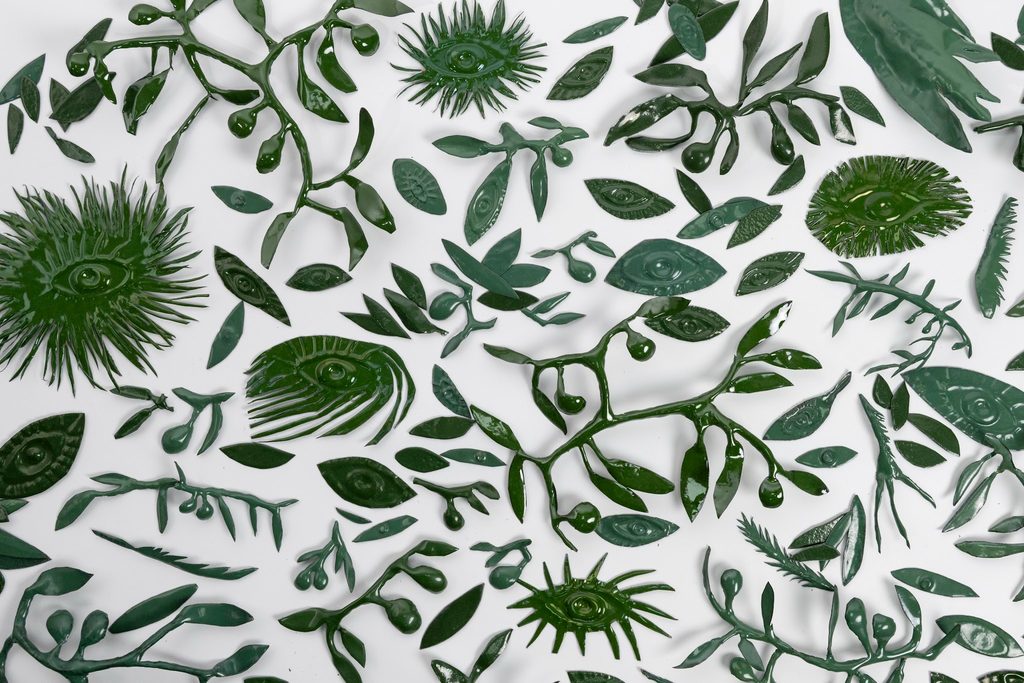
This is an exhibition structured in series, some arranged across two walls and others in two horizontal display cases, all carefully organized and balanced. The central vitrine contains a striking work in enamel and copper, composed of a scattering of olive branches and leaves that seem to move and lift slightly in the wind. Here too, form, material, and the deep, uniform green are treated differently, yet through a reductive approach that succeeds in creating an environment endowed with a life of its own. The seamless enamel enveloping the copper, the dipped immersion, the thickness of the vitreous layer, the fluid drips and sensuous sheen, the precise placement of the elements on the white surface, and the simplicity of the olive leaves – together, these create a fragment of life: a moving, breathing cluster one wishes could spread without limit.
This is an autonomous work of jewelry art, fully capable of standing on its own, whose physical and artistic existence resides entirely in the medium, in enamel, and enamel alone. As both statement and installation, it enters into dialogue with the three central reliefs and reinforces them.
Agate, gold leaf, brass
2 × 3 cm
Photo: Boaz Nobelman
Throughout her career, Shirly Bar-Amotz has carved out a distinctive territory of her own, moving with ease between art and jewelry. In her characteristically systematic way, she has blurred the semantic boundaries between jewel, brooch, and painting; sculpture, readymade, ring, toy, and installation; protest badge, neckpiece, and collection of objects. Her repertoire contains an eclectic and free-ranging element that is present in this exhibition as well, though this time in a more directed and consolidated form. It carries with it a painful restraint and a message of vulnerability, underscored by the exhibition’s title, “I Was Born of Stone.”
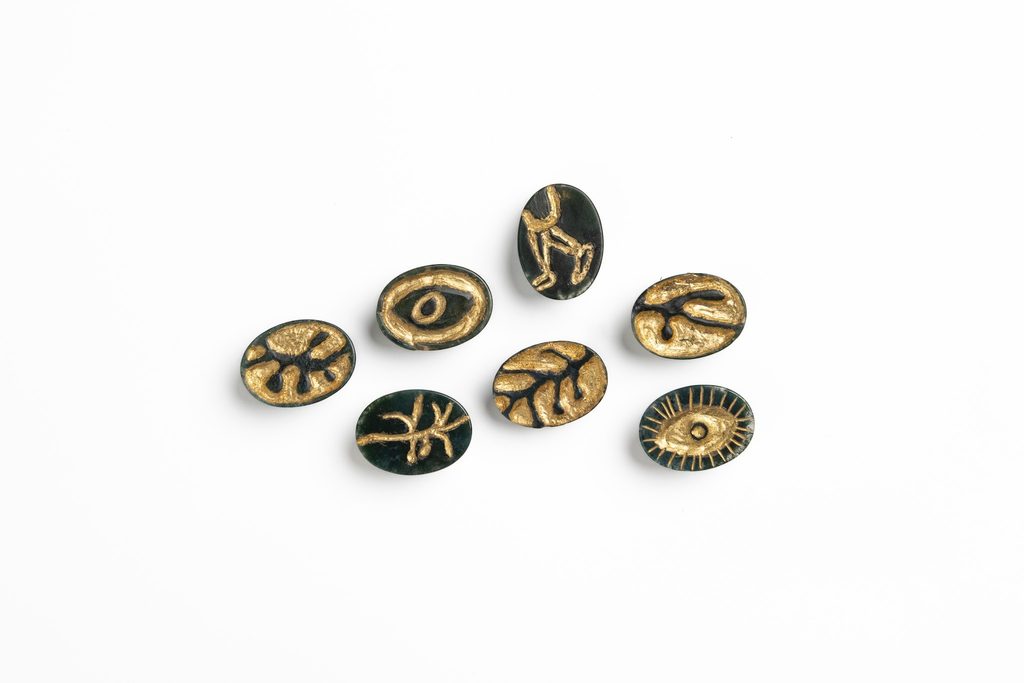
Another register lies in the insistence on the eye as symbol, icon, witness, and organ of emotion. The eye is present in the relief by Bar-Amotz’s grandmother Miriam and recurs throughout many of the works in the exhibition. In the Medusa it expresses profound anxiety; in other creatures it narrows into a drooping slit, opens like the hollow pupil of an emptied socket, or is modeled in the volume of the material as a leaf-like form fringed with dense eyelashes. In several rings and brooches, it also registers astonishment in the face of disturbing sights. The eye functions as a seal as well, and even as the familiar amulet against the evil eye. In all its variations, the dialogue between the archetypal eye and the treatment of the relief, the tonalities of the material, the gold leaf, and the depth of black exemplifies the equivocal position within the arena Shirly has created between craft and art.
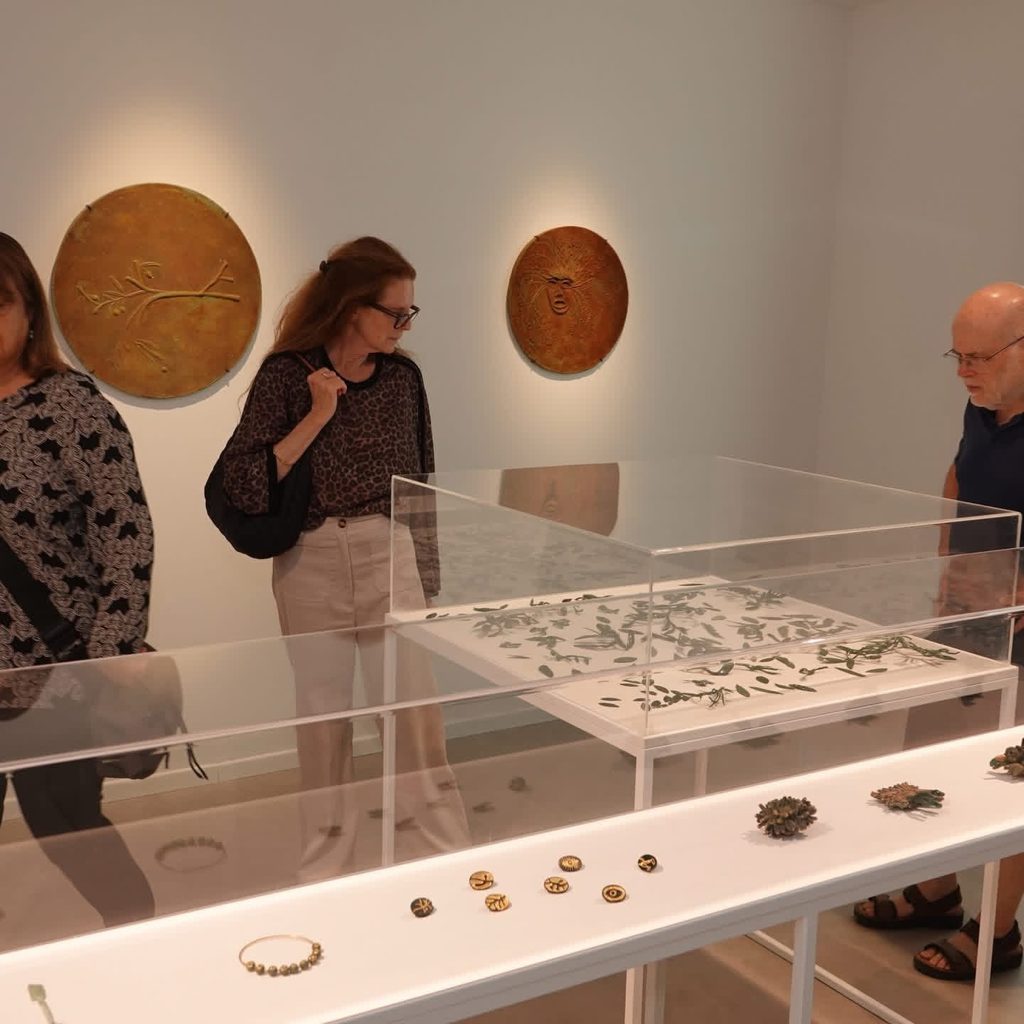
Photo: Assaf Ofek
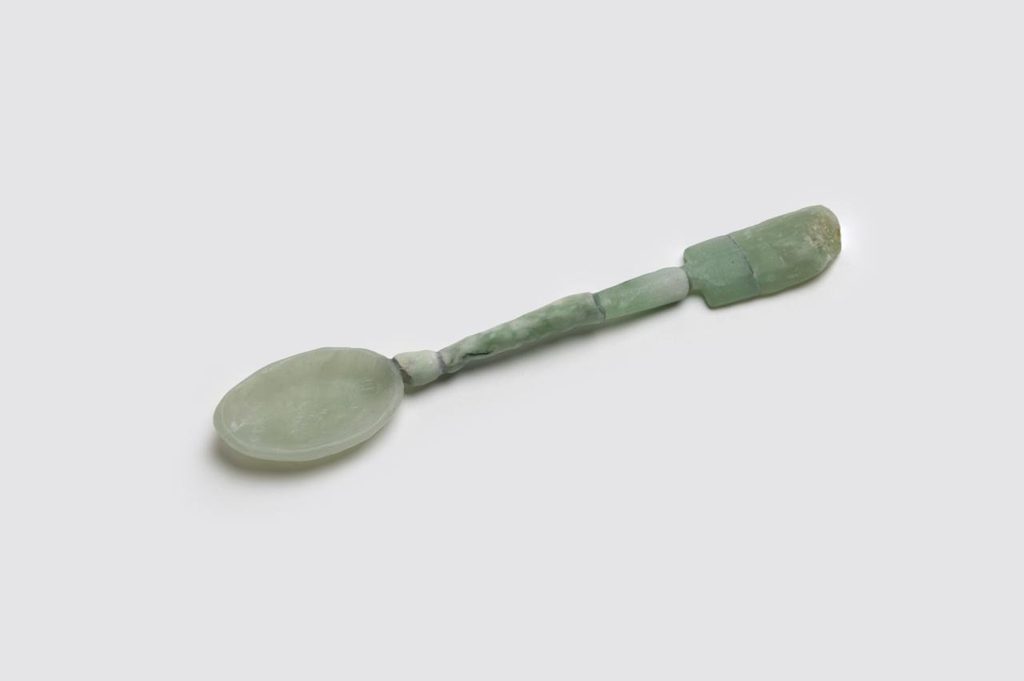
To conclude, I would mention the broken teaspoon, one of the exhibition’s most moving and enigmatic works. It rests in the corner of a vitrine like a dismembered relic, the skeletal remains of a lost silverware set, as though salvaged and reconstructed from its shards as a museum display: an heirloom evoking the lineage of the grandmothers, while asserting a potent, silent socio-political protest.
Aventurine
12 cm × 2.5 cm
Photo: Boaz Nobelman